
The history and philosophy of Aikido
World Aikido Yoga
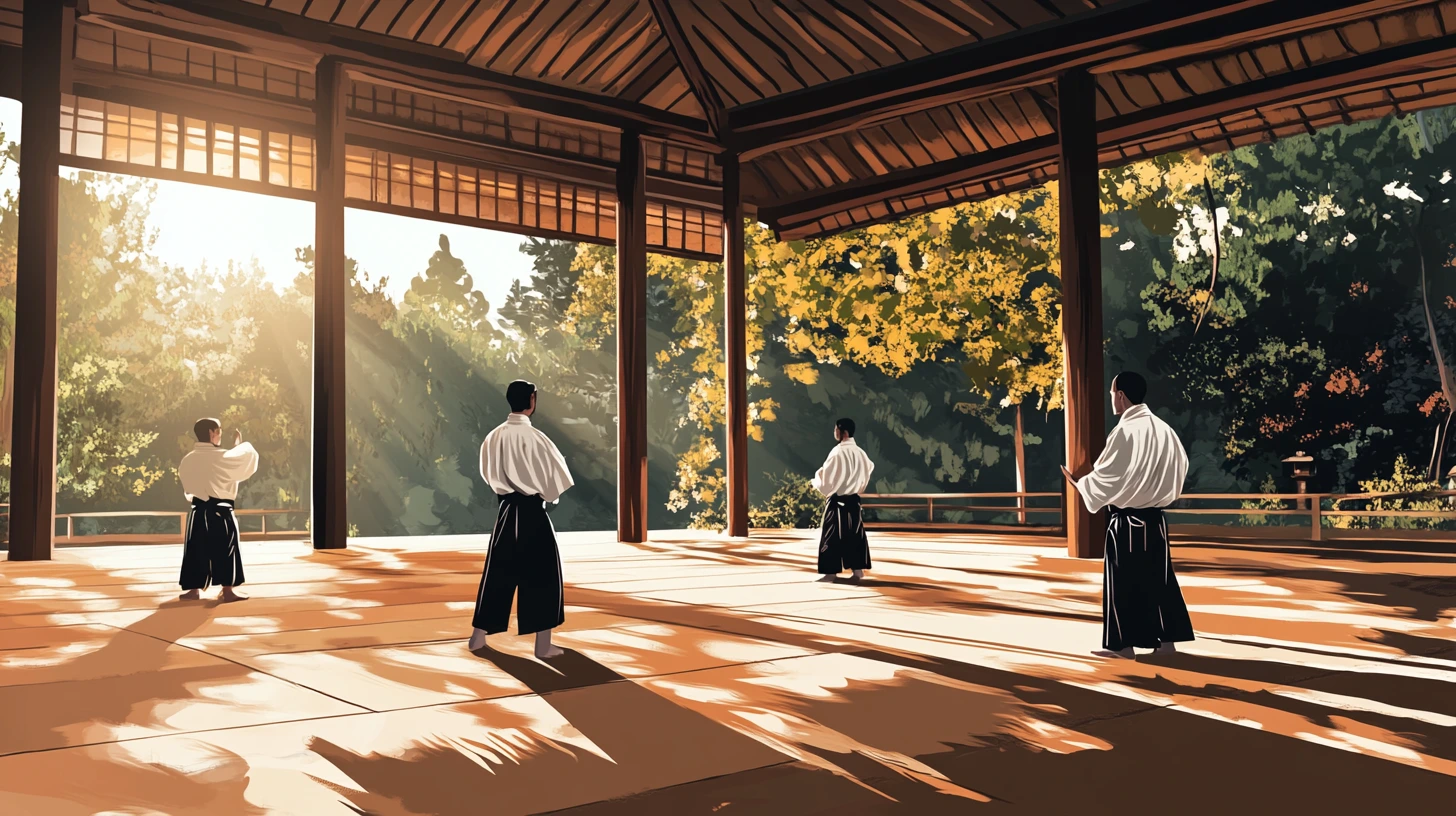
Aikido, a modern Japanese martial art, is often described as more than just a physical practice—it’s a holistic discipline that integrates philosophy, spirituality, and a profound understanding of human movement. This unique blend positions Aikido as not just a method of self-defence, but also a path to personal growth and harmony. In this article, we delve into the rich history and philosophy of Aikido, exploring its origins, evolution, and the principles that guide its practice today.
Origins and historical development of Aikido
The birth of Aikido: Morihei Ueshiba’s vision
Aikido was founded by Morihei Ueshiba, known by his students as Ōsensei, or “Great Teacher.” Born in 1883 in Tanabe, Japan, Ueshiba was exposed to several martial arts early in life, including jujutsu and kenjutsu. However, it was in the early 20th century, through his extensive training in Daito-ryu Aiki-jujutsu under the tutelage of Sokaku Takeda, and his spiritual encounters with the Omoto-kyō religion, that the seeds of Aikido were sown. Ueshiba envisioned a martial art that emphasized peace and harmony, rather than competition and domination.
Evolution and global spread
Ueshiba originally referred to his art as Aiki-budo and Aiki-jujutsu before settling on the name Aikido in the late 1940s. Post World War II, Aikido began to spread beyond Japan due to its non-violent philosophy which resonated with many around the globe. Students such as Koichi Tohei and Minoru Mochizuki played pivotal roles in introducing Aikido to the Western world. By the 1960s, Aikido had established a foothold in North America and Europe, leading to further development and diversification within the art.
The philosophical underpinnings of Aikido
Harmony with the universe
Aikido translates to “the way of harmonious spirit.” This name encapsulates the art’s primary philosophy: achieving harmony with one’s environment and opponents. The concept of ‘ki’, often described as universal energy or spirit, is central to Aikido practice. Practitioners seek to blend their ki with the ki of their opponent to neutralise aggression without causing harm.
The principle of non-resistance
At the heart of Aikido’s techniques is the principle of non-resistance. Instead of directly opposing an attack, an Aikidoka (practitioner of Aikido) uses flowing, circular motions to redirect the force, leading the opponent into a disadvantageous position. This not only minimizes the risk of injury but also embodies the art’s emphasis on maintaining mutual respect and understanding.
Self-mastery and personal development
Aikido is as much about self-discipline and emotional control as it is about physical training. Practitioners learn to maintain calmness and centredness in challenging situations, fostering a sense of self-mastery. This aspect of Aikido aligns closely with mindfulness practices found in other disciplines like yoga, enhancing mental clarity and emotional resilience.
Aikido’s impact on wellness and daily life
Mind-body connection
The practice of Aikido fosters a strong connection between mind and body, promoting holistic health. Studies have shown that regular practice can improve balance, coordination, flexibility, and overall physical fitness. Moreover, the meditative aspect of training can reduce stress, anxiety, and depression, contributing to improved mental health (Smith et al., 2019).
Enhancing interpersonal relationships
Aikido’s emphasis on harmony and empathy can transform interpersonal relationships. By fostering a mindset of understanding and connection, practitioners often find themselves better equipped to handle conflict in personal and professional settings, improving communication and collaboration (Jones, 2021).
Scientific foundations and evidence
Research on martial arts and psychological health
Research indicates that martial arts, including Aikido, can enhance psychological well-being by reducing aggression and increasing emotional regulation (Lakes & Hoyt, 2004). A study by Twemlow et al. (2008) demonstrated that engaging in martial arts can decrease hostility and improve social competence.
Neuroplasticity and martial arts training
Engaging in complex motor skills training, like Aikido, can induce positive changes in brain structure and function, a phenomenon known as neuroplasticity (Taubert et al., 2010). This can contribute to cognitive benefits such as improved memory, focus, and problem-solving skills.
For further reading and references, you can explore the research studies linked:
- Lakes, K. D., & Hoyt, W. T. (2004). The Effects of Martial Arts Training on Mental Health: A Meta-analytic Review. Health Psychology.
- Taubert, M., Draganski, B., Anwander, A., & Jäncke, L. (2010). Dynamic Properties of Human Brain Structure: Learning-related Changes in Cortical Areas and Associated Fibre Connections. Science.
- Twemlow, S. W., & Sacco, F. C. (2008). Why School Antibullying Programs Don’t Work. American Journal of Psychiatry.
Summary
Aikido stands as a unique martial art interwoven with principles that transcend combat and extend into lifestyle and personal development. Its rich history, rooted in Japanese culture and the visionary insights of Morihei Ueshiba, combines physical discipline with deep philosophical and spiritual exploration. Whether one seeks self-defence, fitness, or a path to personal harmony, Aikido offers a comprehensive approach that integrates body, mind, and spirit. Embracing Aikido not only enriches the practitioner but also contributes to a more peaceful and harmonious world.
Feel free to ask if you have any further questions or need additional information!
Frequently asked questions
What are the basic principles of Aikido?+
The basic principles of Aikido include harmony with opponents, non-resistance, self-mastery, and the redirection of force rather than direct opposition. Aikido promotes physical and mental centring, enabling practitioners to handle confrontations peacefully.
Is Aikido effective for self-defence?+
While Aikido is not focused on self-defence per se, practitioners can effectively neutralise aggressive encounters without resorting to violence. The art emphasizes controlling and redirecting aggression, which can be advantageous in real-world self-defence scenarios.
How is Aikido different from other martial arts?+
Aikido differs from many martial arts due to its non-competitive nature and focus on blending with an opponent’s energy rather than opposing it. It promotes a philosophy of peace and harmony, contrasting with martial arts that emphasize striking and dominance.
Can anyone practice Aikido, regardless of age or fitness level?+
Yes, Aikido is accessible to people of all ages and fitness levels. As a non-competitive art, it allows individuals to progress at their own pace, making it suitable for both children and adults looking for a practice that enhances both physical well-being and personal growth.
How do philosophical concepts in Aikido apply to everyday life?+
The philosophical concepts of Aikido, such as non-resistance and harmony, can be applied to everyday life by encouraging peaceful conflict resolution and fostering understanding in interpersonal relationships. These principles can enhance communication, patience, and empathy in daily interactions.